
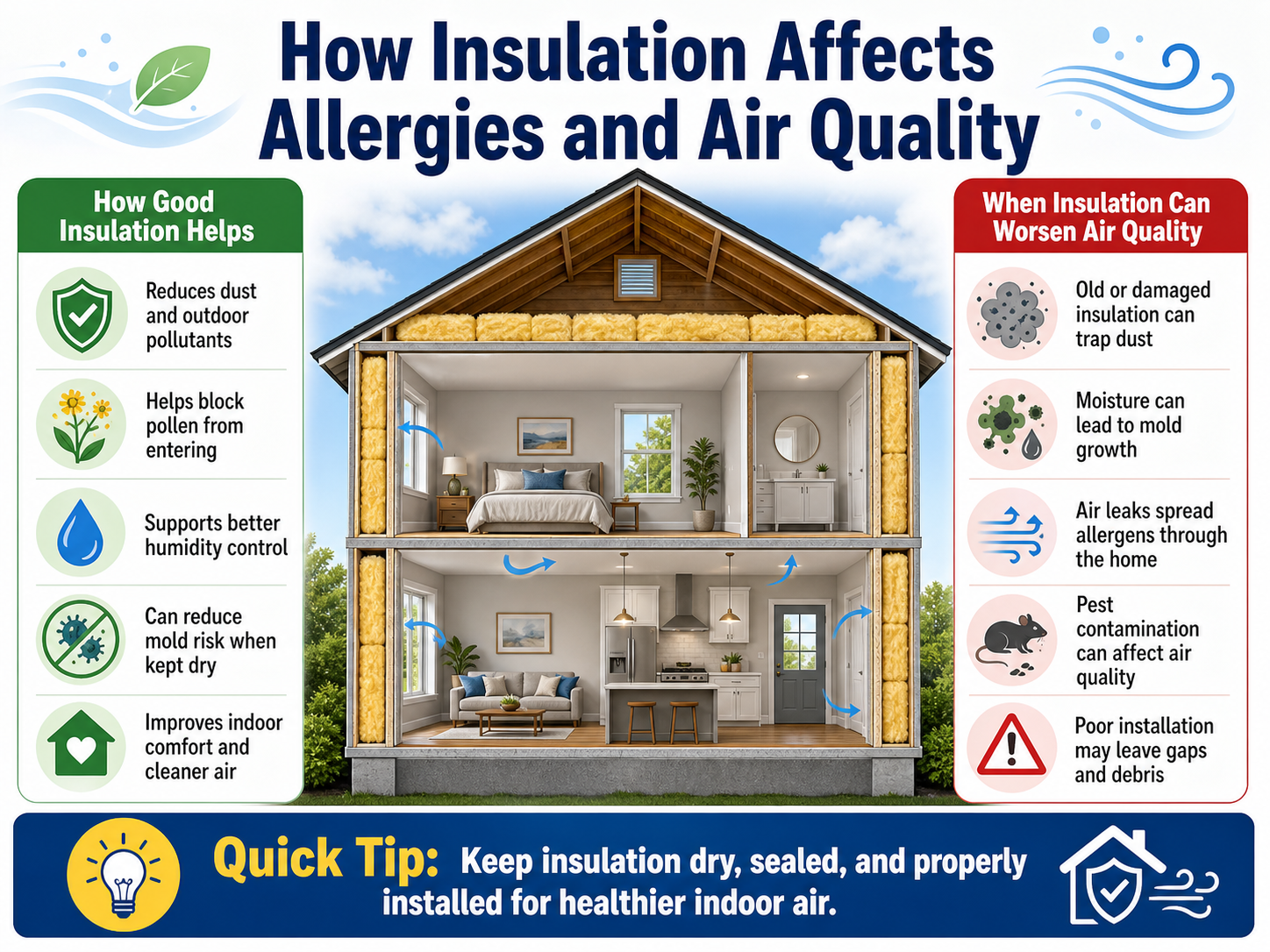
Most homeowners think of insulation purely in terms of temperature — keeping heat in during winter and out during summer. But understanding how insulation affects allergies and air quality reveals a side of home performance that has a direct impact on your family’s health, especially in Indiana’s high-pollen, high-humidity environment.
Insulation influences indoor air quality in two distinct ways — and they can work in opposite directions. Well-installed, appropriate insulation acts as an allergen barrier, sealing the gaps through which outdoor pollen, dust, mold spores, and vehicle exhaust enter your living space. Old, damaged, or poorly chosen insulation, on the other hand, can become a source of airborne irritants itself. Here’s how to tell the difference, and what the right insulation setup actually looks like for an Indiana home.
Insulation Plays a Direct Role in What Enters and Circulates Through Your Home’s Air
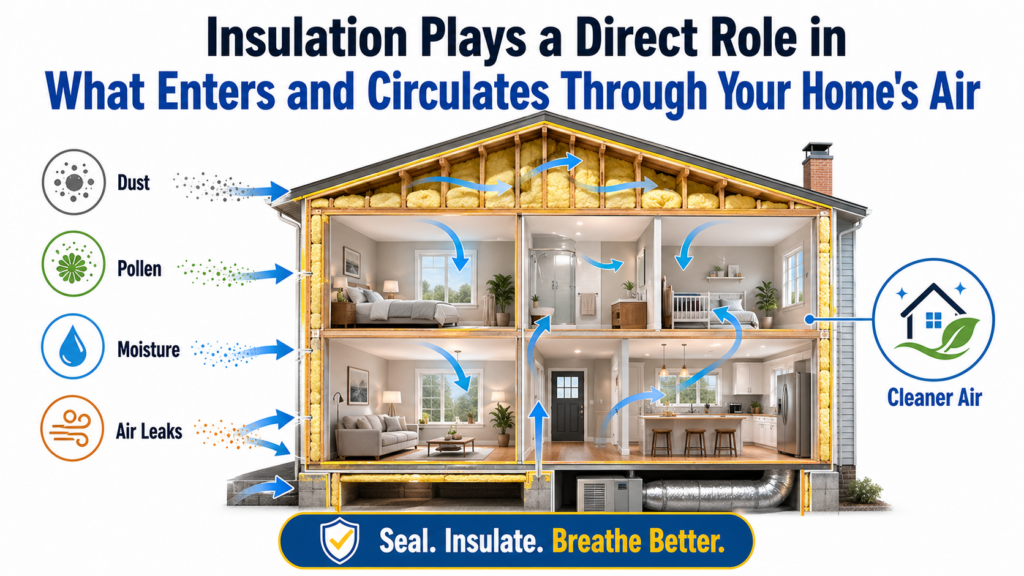
Your home is not a sealed box. Air moves constantly through gaps in the building envelope — around window frames, through penetrations in the attic floor, along rim joists, and through wall cavities that lack adequate insulation. In Indiana, where spring and fall bring heavy pollen loads from trees, grasses, and ragweed, and where summer brings elevated mold spore counts, every gap in your home’s envelope is a potential entry point for outdoor allergens.
This is where insulation — particularly when paired with proper air sealing — makes a measurable difference for allergy sufferers. The most effective approach is not simply filling cavities with insulating material, but addressing the air infiltration pathways that allow outdoor air to bypass your HVAC filtration entirely. Air that leaks directly into your living space through attic hatches, wall gaps, or unsealed penetrations never passes through a filter at all. Insulation that also creates an air barrier — most effectively spray foam, or batt insulation combined with dedicated air sealing — significantly reduces that unfiltered infiltration.
Research consistently shows that homes with higher levels of air sealing have lower concentrations of outdoor allergens indoors. For Indianapolis-area households where one or more family members have seasonal allergies, asthma, or respiratory sensitivities, this connection between building envelope performance and indoor air quality is one of the most practical and overlooked health improvements available.
Old or Damaged Insulation Can Actively Worsen Indoor Air Quality
While good insulation improves air quality, insulation that has degraded, been contaminated, or was never an appropriate choice for the application can become an active source of indoor air pollutants. This is a scenario that affects a significant number of older Indiana homes and one that’s worth understanding before simply adding new insulation on top of existing material.
Mold Growth in Moisture-Damaged Insulation
Insulation that has been exposed to moisture — from a roof leak, a plumbing failure, condensation from an inadequate vapor barrier, or Indiana’s humid summer air in a poorly ventilated attic — creates ideal conditions for mold growth. Mold spores released from contaminated attic or wall insulation can circulate through the home via air movement and HVAC airflow, triggering allergic responses, asthma attacks, and respiratory irritation. Cellulose and fiberglass batts are particularly susceptible to mold when wet. If moisture has reached your insulation and remained there, replacement is generally the appropriate response — not remediation.
Rodent and Pest Contamination
Attic insulation that has been disturbed by rodents carries a different but equally serious air quality risk. Rodent droppings and urine dry and become airborne as fine particulate matter, which can then circulate into living spaces through air leakage and HVAC systems. This is a common scenario in older Indianapolis homes with attic access points that haven’t been properly sealed. Contaminated insulation cannot simply be disinfected and reused — it needs to be removed, the attic sanitized, and fresh insulation installed after pest entry points are sealed.
Fiberglass Particle Release
Undisturbed fiberglass insulation that is properly installed and covered poses minimal air quality risk. However, fiberglass that has been disturbed — by renovation work, pest activity, or repeated foot traffic in the attic — can release fine glass fibers into the air. These particles are irritants to the eyes, skin, and respiratory tract. If your attic insulation is loose, visibly disturbed, or has been accessed repeatedly without protective measures, having it assessed and potentially replaced is worthwhile for anyone with respiratory sensitivities in the household.
Off-Gassing from Older Insulation Materials
Homes built or renovated before the 1980s may contain insulation materials that are no longer in use due to health concerns. Urea-formaldehyde foam insulation, which was popular in the late 1970s, is known to off-gas formaldehyde — a respiratory irritant and known carcinogen — particularly as it ages and degrades. If your home was insulated during that era and hasn’t been upgraded, having the existing material identified and assessed is a reasonable precaution.
Which Types of Insulation Are Best for Allergy and Air Quality Concerns?
Not all insulation materials perform equally from an air quality perspective. When allergy management and indoor air quality are priorities, the choice of insulation type and installation method both matter.
- Closed-cell spray foam: The strongest performer for air quality applications. Creates a rigid, seamless air barrier that eliminates infiltration pathways and resists moisture, mold, and pest intrusion. Contains no loose fibers and does not support mold growth. Ideal for rim joists, crawl space walls, and attic roof decks where air sealing is the primary goal.
- Open-cell spray foam: Also provides excellent air sealing with a softer, more flexible structure. Highly effective at blocking infiltration while conforming to irregular surfaces. Vapor-permeable, so moisture management through other means remains important in humid Indiana summers.
- Mineral wool (rock wool): Naturally resistant to mold and moisture, does not support microbial growth, and is non-combustible. A strong choice for walls and areas with moderate humidity exposure. Denser than fiberglass, which reduces air movement through the batt when properly installed.
- Blown-in cellulose: Treated with borate compounds that inhibit mold growth and deter insects — a meaningful advantage over untreated materials. When dry and undisturbed, cellulose poses low air quality risk. Its vulnerability is moisture; wet cellulose can mold despite borate treatment if the moisture source isn’t resolved.
- Fiberglass batt: Inert when undisturbed and dry. The air quality concern with fiberglass is less about the material itself and more about installation quality — gaps and compression points that allow air movement around the batt undermine both thermal performance and the allergen barrier effect.
For households with significant allergy or asthma concerns, spray foam for air sealing at critical infiltration points — combined with blown-in or batt insulation for thermal performance — is typically the most effective combination for both energy efficiency and indoor air quality.
Pairing Insulation with Proper Ventilation Is Essential for Healthy Indoor Air
One of the most important — and most frequently overlooked — relationships in home performance is the one between air sealing and ventilation. Tightening a home’s envelope reduces allergen infiltration, but it also reduces the natural air exchange that previously diluted indoor pollutants. In a well-sealed home without a dedicated ventilation strategy, volatile organic compounds (VOCs) from building materials and furnishings, carbon dioxide from occupants, and moisture from cooking and bathing can accumulate to levels that affect comfort and health.
The solution is not to leave gaps in the insulation — it’s to ventilate intentionally rather than accidentally. This is where an Energy Recovery Ventilator (ERV) becomes a critical complement to high-performance insulation. An ERV continuously exchanges stale indoor air with fresh outdoor air while recovering most of the thermal energy from the outgoing airstream — so you get the air quality benefit of fresh air without the energy penalty of simply opening a window in January.
Homeward Insulation installs Energy Recovery Ventilators for Indianapolis-area homeowners as part of a complete approach to indoor air quality. For homes that are being upgraded to higher insulation levels, adding an ERV at the same time is the most cost-effective way to ensure that tighter envelope performance translates into better air quality — not just lower energy bills.
Humidity control is equally important in Indiana’s climate. Summer humidity that enters a well-sealed home through normal occupancy activities needs a pathway out. An ERV manages this exchange continuously, reducing the risk of elevated indoor humidity that drives mold growth and dust mite populations — two of the most common allergy triggers in Midwestern homes.
How Do You Know If Your Insulation Is Contributing to Air Quality Problems?
The connection between insulation and indoor air quality isn’t always obvious. These are the signals that suggest your home’s insulation may be affecting the air your family breathes:
- Allergy or asthma symptoms that are consistently worse indoors than outdoors, or worse in certain rooms
- A persistent musty odor in the attic, basement, or crawl space — often a sign of mold in moisture-damaged insulation
- Visible mold on attic sheathing, joists, or insulation material
- Evidence of past or current rodent activity in the attic or crawl space
- A home built before 1985 that has never had an insulation assessment
- Increased dust accumulation throughout the home, particularly after the HVAC system runs
- Itching, eye irritation, or respiratory symptoms that correlate with attic access or HVAC activity
- High indoor humidity levels in summer despite air conditioning running normally
Any of these signs warrants a professional insulation assessment. At Homeward Insulation, we evaluate not just the thermal performance of your existing insulation but its condition — looking for moisture damage, contamination, and air infiltration pathways that may be affecting your home’s air quality. We also assess whether an ERV or other ventilation upgrade would benefit your specific situation.
Frequently Asked Questions About Insulation, Allergies, and Indoor Air Quality
Can adding insulation actually help reduce allergy symptoms?
Yes — when insulation is combined with proper air sealing, it can significantly reduce the infiltration of outdoor allergens like pollen, mold spores, and dust into your living space. The key is addressing the air leakage pathways, not just adding thermal mass. Spray foam at rim joists, attic penetrations, and other infiltration points provides the most direct allergen barrier benefit. For households with seasonal allergy sufferers, this improvement can be meaningful and measurable.
Is fiberglass insulation dangerous for people with respiratory conditions?
Undisturbed, properly installed fiberglass insulation in walls and attics is generally not a health concern for occupants. The risk arises during installation or disturbance, when fine glass fibers become airborne. For homes with occupants who have significant respiratory sensitivities, mineral wool or spray foam alternatives may be worth discussing with your insulation contractor, as both have better profiles in terms of fiber release. If you’re concerned about existing fiberglass insulation in your home, a professional assessment can determine whether it poses any current risk.
Can insulation help with dust mite allergies?
Insulation addresses dust mite allergies indirectly. Dust mites thrive in warm, humid environments — and a well-insulated, properly ventilated home maintains lower indoor humidity levels, which is unfavorable for dust mite populations. Sealing air infiltration pathways also reduces the introduction of outdoor particulates that dust mites feed on. These are contributing factors rather than a direct solution, but they’re meaningful components of a comprehensive approach to dust mite reduction.
What is an Energy Recovery Ventilator and why does it matter for air quality?
An Energy Recovery Ventilator (ERV) is a mechanical ventilation system that continuously exchanges stale indoor air with fresh outdoor air while transferring heat and moisture between the two airstreams — so you gain fresh air without significant energy loss. In a well-sealed home, an ERV prevents the buildup of indoor pollutants, excess humidity, CO2, and VOCs that would otherwise accumulate without natural air leakage. For Indianapolis homeowners upgrading their insulation, an ERV is often the most important complementary investment for long-term indoor air quality.
Does Homeward Insulation handle mold-damaged insulation removal?
Yes. When an insulation assessment reveals moisture damage, mold growth, or contamination from pests, Homeward Insulation handles removal of the affected material as part of our service. We do not simply add new insulation on top of compromised existing material. After removal, we address the underlying moisture or air sealing issue, then install fresh insulation to current performance standards. Contact us or fill out our free estimate form to schedule an assessment of your attic, crawl space, or wall insulation.
Better Insulation Is One of the Most Impactful Air Quality Upgrades You Can Make
The relationship between your home’s insulation and the air your family breathes is more direct than most people realize — and in Indiana, where outdoor allergen seasons are long and humidity is a year-round challenge, getting that relationship right matters. The right insulation, properly installed and paired with intentional ventilation, seals out outdoor allergens, prevents the moisture conditions that drive mold and dust mites, and creates an indoor environment that supports better respiratory health.
At Homeward Insulation, we take a whole-home view of insulation performance — looking at thermal efficiency, moisture management, air sealing, and ventilation together rather than treating each as a separate issue. Whether you’re dealing with allergy symptoms you can’t explain, a musty attic, or simply an older home that’s never been properly assessed, we’re here to help. Fill out our free estimate form online and let us take a look at what your home’s insulation is — and isn’t — doing for your indoor air quality.